Tag Archives: Facebook

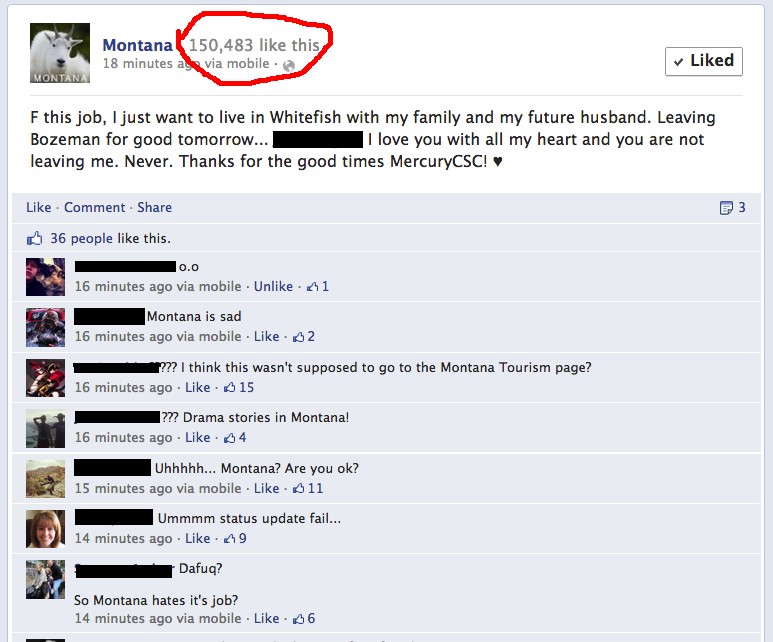
Montana tourism facebook posting

UPDATED: Social media manager seems to quit job very publicly on Montana state tourism Facebook page

Sometime early this morning, a post appearing to be from a disgruntled social media marketer went public on the state of Montana’s tourism page on Facebook.

Around 2:30 or 3:30 this morning, the following message went out to the page’s roughly 150,000 followers:

F this job. I just want to live in Whitefish with my future husband. Leaving Bozeman for good tomorrow [...] Thanks for the good times MercuryCSC!

MercuryCSC is an advertising agency based in Bozeman and San Francisco. Outside magazine this year named the company one of the 30 best places to work.

The company lists its work with the state’s tourism office as one of its case studies. “Mercury’s work for the Montana Office of Tourism has been widely recognized as some of the most effective and innovative tourism marketing in the nation,” the Web page says. There’s a video touting the success of the campaign on Vimeo.

The posting has since been deleted, to the chagrin of entertained followers, if the “posts by others” on the Facebook page are to be believed.

The posting does live on in screenshots and on Reddit.

Sarah Lawlor, spokeswoman for the tourism office, said the state office works closely with Mercury in its social media strategy, so Mercury employees do have administrative rights to the Facebook page.

“They usually run everything they will post through us first,” Lawlor said.

“It was a personal error by this person, and once they realized this error, we removed the post,” she said. “Obviously, it wasn’t content intended for our Facebook audience.”

The Office of Tourism will post an explantory statement to its page today.

Lawlor said it was too soon to tell whether the incident would affect the office’s relationship with Mercury.

“We’re going to have to have that discussion internally,” she said. “We haven’t had a chance to do that yet, but there will certainly be some review.”

MacLaren Latta at MercuryCSC said she could not discuss the matter since was a personnel issue. She also could not say whether the person in question was still with the company.

Update: MercuryCSC has released a statement about the incident, noting that it is no longer doing social media work for the state’s tourism office.

At approximately 2:15 a.m. on Friday, December 7, 2012, an employee of MercuryCSC made a mistake and posted unprofessional personal comments as ”Montana” to the Montana Facebook page.

As soon as the post was discovered, it was removed. However, images of the post were distributed throughout social media and news channels causing confusion and speculation about the source and the nature of the post.

MercuryCSC no longer has administrative rights to the Montana Facebook page, and MercuryCSC is no longer performing social media work for the Montana Office of Tourism.

MercuryCSC accepts responsibility for and is actively working with the Montana Office of Tourism to address the situation.

MercuryCSC regrets this chain of events. We apologize to our client and the state of Montana for this issue.

As it is a personnel matter, we are not able to make additional comments.

Wilcoxson's Logo

Wilcoxson’s moving on from Facebook flap

Wilcoxson's LogoWilcoxson’s, the Livingston-based ice cream company whose president drew the fury of the Internet a few weeks ago over an insensitive comment on its Facebook page, has told its online fans that it’s done talking about the matter.

On the company’s restored Facebook page, it writes that while Wilcoxson’s has allowed discussion of the Sept. 21 commenting incident, the company is ready to move on.

“We are not going to continue to host a public discussion about this incident any longer,” the company writes on its page.

In the spirit of civility, we feel the conversation has turned into a rant we can no longer support here. We want to thank the people that emailed us questions and those that made thoughtful comments here, even though they were negative. We deserved to be criticized. We let down our fans and customers, and for this we are truly sorry.

On Sept. 26, the Chronicle reported Wilcoxson’s president Matt Schaeffer, responding to a Wyoming Muslim’s question about whether the ice cream’s gelatin was kosher, had said:

“We don’t deliver outside of Montana, certainly not Pakistan.”

The comment provoked immediate angry responses from friends of the Wyoming man, and soon screenshots and news of the comment were posted to Reddit and other online news sources.

The response was so negative that Schaeffer decided to take the Facebook page down entirely.

People posted such nasty things on the Wilcoxson’s page that he deleted it and said, “It’s no longer going to be in existence.”

In a later interview with the Billings Gazette, Schaeffer softened his social media stance, saying, “The page will be put back up soon. It will be run by somebody other than myself, who is more adept at it.”

Schaeffer originally had taken over the page from a fan after the fan said the page became too much work.

The page is back now, and whoever is running it has made sure to address the comment controversy.

UPDATE FROM WILCOXSON’S: For several days, we have been hosting a discussion on Facebook about an incident that happened in September where our president made an insensitive comment to a customer online. Our president has apologized publicly and the company has apologized as well (please see our About section). In the spirit of civility, we feel the conversation has turned into a rant we can no longer support here. We want to thank the people that emailed us questions and those that made thoughtful comments here, even though they were negative. We deserved to be criticized. We let down our fans and customers, and for this we are truly sorry. You can continue to email us at [email protected] or message us here.

We feel that it is time to give our Facebook page back to our fans and friends. Be assured we read every comment you made and will take it to heart. We are in the midst of having discussions about how to change our customer service protocol so this doesn’t happen again. This incident does not reflect the true heart and culture of our company and we are saddened to think that people might think poorly of our company because of this one incident.

Unfortunately, for the sake of our community, we will delete comments and ban users who continue to violate the posting guidelines in our About section. We wish it wasn’t this way, but we feel the conversation has run its course. Thanks again to those who have supported us—we will work hard to regain your trust.

The above posting currently has 71 likes and 54 comments. Most of those comments are positive; considering the moderation policy outlined above (and in this comment from the company), that’s not surprising.

The page has 3,279 fans.

Update – A commenter notes that Wilcoxson’s mistyped their email address in the message I relayed here. Correct, it is wilcoxsonsinc@gmail.com.

More issues related to quoting from social networking profiles
I wrote Wednesday about a social networking issue: Should journalists quote from sources’ social media profiles?

I had a few more thoughts to share that didn’t quite fit into that post, so I thought I’d file a kind of disjointed follow-up.

The Heinous Crime Provision

First of all, media organizations already quote regularly from personal social media profiles — it just happens to occur most often, at least in my experience, when the person in question has committed some kind of horrible crime, like shooting up a crowded theater.

I’m not sure any of us watching at home really think of this kind of quoting at “not OK,” though we may think it isn’t strictly necessary. Still, in situations like that, the media-viewing public is thirsty for any information about the criminal it can get, and social media profiles provide a glimpse into the perp’s mind.

Does this kind of “mass murderer” provision filter down to the level of the average Facebook user who hasn’t committed an atrocity? These people don’t have the same weight of public scrutiny on them that high-profile criminals do, so do we treat their privacy differently? Are we treating the high profile criminal’s privacy with irresponsible recklessness? (Consider that most of this media scrutiny happens directly after the crime and before any sort of court proceedings have determined that person’s guilt.)

I don’t have answers for these questions, by the way. Sorry to disappoint.

The Integrity of Quotes

Second, I keep coming back to this thing I wrote:

Second, why would we necessarily give someone a chance to rephrase their wording for the media? If you see something interesting on a person’s Facebook profile and want to quote it but then you do decide to call the person first, what is he going to do? He’s going to reword himself, polish up the quote — make it media-pretty.

I suppose it’s up to the reporter to decide whether it’s OK for the source to present a media-savvy front or to be quoted in situ. If the quote is worth quoting and it’s public, I’d say go use it.

We do this all the time already. When I worked in public relations at the local university, before rejoining the newspaper, we did it. We let sources edit and then OK their quotes.

Sometimes in the modern newsroom, we call sources before a story runs and read quotes back to them. This is done to make sure the quotes are accurate. The ethical reporter shouldn’t change a quote at a source’s request — probably — especially not if it is simply to make the source look better.

But what if the change the source requests improves the accuracy of the quote? What if changing one word is the difference between being wrong and right? Do you edit the existing quote to reflect the change or make them say it again? Is it enough for the source to say to you over the phone, “That quote you read me? Add in that one word and then consider that to be what I said.”?

Quotations are always tricky when the interview wasn’t recorded or when it was just you and the source in a one-on-one discussion. If a reporter has nothing but her notes as the record, then who is to say that when you sit down to write out that story that you got that source’s words exactly right? Add to this the fact that most people wouldn’t be able to tell you the precise words they spokes hours or days before.

With the social networking thing, you have a record of exactly what was said, and even if you call a source back and ask them about the thing they typed as a status update, all the pretty quotes they can give you over the phone doesn’t change the fact that they wrote it in the first place.

But then again…

What if the source changes the privacy settings on the post in question after a journalist has seen it? Can they pull something back out of the public sphere after it has been seen?

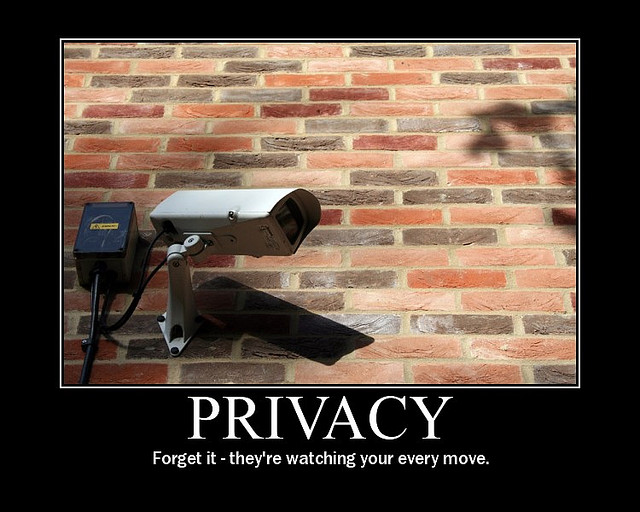
Privacy by Dave Pearson on Flickr http://www.flickr.com/photos/davepearson/420884893/

Is it OK to quote sources from social network posts?

Privacy by Dave Pearson on Flickr http://www.flickr.com/photos/davepearson/420884893/Jamee Greer, who works with the Montana Human Rights Network, put up an journalistically interesting post on his personal Facebook wall yesterday. In it, Greer says that a Missoulian guest columnist quoted him from a posting on his personal Facebook profile without directly contacting him.

(Beware, we are about to get into the deep meta-criticism world in which I discuss and quote things from Facebook in a post in which I discuss the appropriateness of quoting things from Facebook.)

Background

The column in question was by writer and activist Dave Stalling, who wrote Aug. 14 about Joseph Baken, the young man who told police he was assaulted at a Missoula bar for being gay when in reality he hurt himself trying some flip stunt that wound up on YouTube (from multiple angles even).

In his column, Stalling writes:

Jamee Greer of the Montana Human Rights Network is right on when he says bias crimes are about more than just the person who is at the end of an assailant’s fist. “They are about all of us. They are about silencing us, about intimidating us – about sending a message that we are not welcome in our own communities,” he says. “They try to send the message that we are an ‘other’ wholly undeserving of not just basic legal protections like marriage rights or non-discrimination in the workplace – but not even the right to immediate personal safety and physical security for ourselves and those we love. They are about hate and fear and terrorism.”

The thing is, that quote comes from a posting Greer made Aug. 6 to his personal Facebook account.

Greer is one of the hundreds of people I happen to be friends with on Facebook, so I was able to verify this, just as I was able to see the initial exchange about Greer seeing his words quoted in the Missoulian column. Both postings are listed right now as being shared with “Jamee’s friends,” and not as a public post, so I will not provide links. I don’t know if that ever changed or if they were limited visibility posts the whole time.

About five hours after Greer made his initial post about the column quote, Stalling responded to Greer on Facebook to explain himself. Stalling said he had earlier quoted Greer’s Facebook postings in a blog post that Greer had “liked” and commented on, so he assumed it was OK to quote him in the column.

Greer wrote in his original post that the incident has made him paranoid about what he posts on the social network, and he writes in a comment later that he will be limiting some of his Facebook postings as a result.

Enough of the details. Let’s move on to the theoretical question at the heart of all this:

Is it appropriate for a journalist or columnist to quote from someone’s Facebook page?

What others say

In January, Vince Duffy of the Radio Television Digital News Association asked a similar question. He didn’t come to any conclusions, and the three (yes, only three) reporters he spoke to about it had mixed opinions — one of which was that it was “lazy” to quote social network profiles without contacting a source.

Poynter took up the matter of social network privacy in March. In her article, Nisha Chittal addresses both Twitter and Facebook, but we’ll leave the tweeting aside for now.

Chittal rightly notes that Facebook’s privacy settings are complicated. While it is possible to limit your postings to friends or subsets of friends, general users might not know that or might not even realize their posts are being sent out into the wider world labeled “public.”

The conclusion of Chittal’s column, however, is that it’s still up in the air. There are many useful things reporters can find out in public on Facebook and many things that can lead them on to good contacts with sources and more background information about someone based on their likes and connections.

But to actually quote from a publicly available Facebook page without contacting the person first… Well, that’s a choice that seems to be made on a case-by-case basis, and Chittal lists a series of questions writers can ask themselves before quoting such material.

How I see it

Yes, you can quote people directly from their social networking profiles. No, you don’t need to make an effort to reach them directly, though that might be better in many cases.

However, the postings you quote must be publicly visible.

(You used to be able to search public Facebook posts via YourOpenBook, but Wikipedia tells me the site was shut down in July for legal reasons. You can still limit search results inside Facebook to only public posts, though.)

Now, Greer’s postings are currently set to be visible only to his Facebook friends. I don’t believe a social network friend should take advantage of that relationship to quote things openly. In this particular case, Stalling should have spoken to Greer first.

Back to why I think it’s OK to quote from social media without contacting a person.

First, and call me cold-hearted, but if you haven’t managed to figure out the privacy settings in Facebook, you need to learn them.

Second, why would we necessarily give someone a chance to rephrase their wording for the media? If you see something interesting on a person’s Facebook profile and want to quote it but then you do decide to call the person first, what is he going to do? He’s going to reword himself, polish up the quote — make it media-pretty.

I suppose it’s up to the reporter to decide whether it’s OK for the source to present a media-savvy front or to be quoted in situ. If the quote is worth quoting and it’s public, I’d say go use it.

That’s not to say I think you should use Facebook posts lightly. In fact, I’d be inclined to use the postings only as a last resort, unless the quote itself is the impetus for the story. And if a newspaper is basing a story on a social media post, then it had better be a public figure flubbing up or a fluffy feature — both cases in which you’d contact the person involved for more information or a response.

Finally: Don’t post things on the Internet unless you want them to be public. No matter what security or privacy settings you have in place, you are transferring information to another computer on a worldwide network. Don’t expect privacy.

General Guideline

I’m going to pass the buck and say it’s got to be a case-by-case analysis. There’s no way to make a single rule for something this fluid.

Facebook buying Instagram

In what will undoubtedly be the biggest social media story of the day, Facebook announced that it is buying the popular photo-sharing service Instagram for $1 billion.

Facebook CEO Mark Zuckerberg announced the news on his Facebook timeline, of course. In the post, Zuckerberg writes that Facebook needs to be “mindful about keeping and building on Instagram’s strengths and features rather than just trying to integrate everything into Facebook.” Accordingly, Instagram will be kept independent of Facebook, he said.

In his own blog post, Instagram CEO Kevin Systrom wrote:

It’s important to be clear that Instagram is not going away. We’ll be working with Facebook to evolve Instagram and build the network. We’ll continue to add new features to the product and find new ways to create a better mobile photos experience.
In its formal press release, Facebook said the deal is expected to close this quarter.

According to a report on AllThingsD, San Francisco-based Instagram had 30 million users on the iPhone before releasing an Android app last week, which quickly drew in a million more users.

idog

Why we allow anonymous comments

A reader recently wrote in asking why the Chronicle allows anonymous or pseudonymous comments on its website while requiring that letter writers verify their names and addresses before their letters are printed.

It was a hard question for me to answer, if only because it seemed obvious that we should be offering anonymous comments — despite the headaches they give me on an almost daily basis. Yet when I sat down to write back to this reader, “obvious” did not translate into “easy to explain.”

I knew we should offer anonymous comments. We always have. Yet, why was that? Did someone make a measured decision at some point in the Chronicle’s online past? I know we didn’t question continuing the practice when we upgraded to a new website in 2010.

So I started reading back through my links and finding new ones. (The bookmark trail is here.) I found what Mathew Ingram had to say at GigaOm particularly useful in putting together my answer. Also useful was “No Comment” by Rem Rieder at the American Journalism Review.

At any rate, this is the response I sent to the reader. Let me know how you think I did in the comments.

Sorry to be long in replying, but your question is a really solid one. There are so many arguments back and forth out there in the world of journalism that it was hard for me to find a way to encapsulate that for you.

Yes, we require verified names for letters to the editor. No, we don’t do any verification for online comments — all you need is a working email address to open an account on our website.

Is that a discrepancy? Not in my view. Online comments are not letters to the editor. They are two different ways for our readers to submit comments, and they are both the product of the mediums they were created for. They come from different worlds; we cannot hold one to the standard of the other.

I agree that the state of discourse in the comment section is awful. The commenters are often vicious, mean, bigoted and spiteful, but requiring real names online would box out some of the commenters who rely on anonymity to express themselves without fear of repercussion or punishment.

Besides, experience has shown that a vile environment in the online comments section is less a product of anonymity or pseudonymity than it is a lack of staff engagement with readers. If our reporters more often took part in the online discussion, answering reader comments and questions, the tenor of the discussion there would improve. Commenters would begin to see that a human being reads and reacts to comments, rather than the website being a forum for shouting into the void.

More staff engagement is something I would like to see in the future. Unfortunately, our reporters have their hands full just covering their beats and writing their stories. Asking them at this point to moderate the comments beneath their stories would be too burdensome.

Another major reason for not requiring real names online is that it would be nearly impossible to verify them without requiring people to submit Social Security numbers, credit card numbers or some other identification, which the Chronicle would then have to process. This would guarantee real names are used online, but it would be laborious and expensive for the Chronicle. It would exclude readers who lack the proper identification—as well as people who need anonymity or a screen name to comment on controversial topics.

A few newspapers in the country have experimented with verification systems. Some have switched to Facebook comments for this purpose because that site has a reputation for requiring real names (though it does not verify identities either). The newspapers that have experimented with these systems have seen the number of comments posted to their sites drop dramatically, and they have generally not seen an improvement in commenters’ online behavior.

I am not interested at this time in stifling the comments of those who cannot verify their identities with a credit card number. Neither am I interested in losing a lot of our commenters. These people are regular readers who spend lots of time talking — yes, quite often rudely — about the news and the issues surrounding it. Comments are an outlet for them.

We do moderate comments. Readers have the ability to flag comments as inappropriate, and I and others at the paper look through the comments we receive daily. Those that are clearly against policy are removed. Sometimes commenters are contacted via email to discuss a comment and its deletion. Sometimes, off-color comments remain because, while impolite, they may add to a discussion. There is no accounting for taste, as they say.

As to the accuracy of commenters’ statements, I can make no warranty. People get things wrong, and they lie. It’s the way people are. I cannot fact check the hundreds of comments we receive each day. It’s up to other commenters to continue the debate, showing the errant commenter why he is wrong and citing evidence to show it.

There are financial reasons for wanting a large number of commenters as well. I won’t get into that because it’s not really a factor in the philosophy I’ve laid out here.

In summary, the Web is not the newspaper. People interact with the two mediums in different ways, and users of both the print edition and the website have different expectations for what each product will offer. Online, one expectation is the ability to comment on articles pseudonymously.

I think that feature allows readers freer expression than would binding them to their real names, and while individual comments may be awful to read, I think the entire enterprise is worthwhile.

195774_205453649489480_4485900_n

A note about the police reports on Facebook

The jig is up.

Some of the fans of the Chronicle Police Reports page on Facebook have noticed that the blotter items posted there are not posted on the same day they appear in the paper or online. In fact, some of them appear on Facebook several weeks after they first appeared in print.

There is a reason for that, and it involves a little math, so bear with me.

We post five times a day to the Chronicle Police Reports page, at 9 a.m., noon, 3 p.m., 6 p.m. and 9 p.m. We chose five time slots so that we aren’t overwhelming our followers’ walls/timelines with amusing glimpses of small-city crime.

These are automatic posts — we use a service called Hootsuite to schedule them ahead of time. You’ll have to forgive me for automating part of the process, but it makes life a lot easier to schedule a month’s worth at a time rather than counting on me to remember to post them five times a day.*

Figure that on a typical day when our reporters turn in the police reports, there are between 10 and 20 items listed there. Some of them will be mundane, and we try not to post the mundane ones on Facebook, so you can shave a few reports off that total.

Now, with just five posting slots per day and 10 to 20 new items each day, you can see how we quickly fall behind the print edition’s publishing schedule.

That is why you see some of the reports weeks after you may have read them in the paper or online.

I understand this can lead to some confusion on certain blotter items, but I figure that the entertainment value of the police reports transcends the dates of the incidents involved.

If you’d like to discuss this, feel free to add comments below or to email me at [email protected] or call me at 406-582-2657.

*If you are devastated or otherwise offended to learn that we automate the postings here, I offer this insider tip by way of apology: I try to schedule what I deem to be the funniest reports for the 6 p.m. and 9 p.m. time slots. Enjoy!

Departing the social network

Česky: Logo Facebooku English: Facebook logo E...

Image via Wikipedia

Jenna Wortham at the New York Times gives us this article today, telling the stories of people who are living outside the Facebook empire.

Some of them have never joined up in the first place, but others have quit the site, saying that they are concerned about their privacy. Others worry about the growing gap between themselves and their real world friends. One former user told the Times “I was just seeing their pictures and updates and felt like that was really connecting to them.”

More interesting to me than the reasons people aren’t on Facebook are the comments from Susan Etlinger, analyst at the Altimeter Group. “People may start to ask the question that, if you aren’t on social channels, why not?” she told the paper. “Are you hiding something?”

Societal norms are shifting. That much is certain. Up in the air is whether or not you think the change is a good thing or a bad thing. So… What do you think?

Meet the new Facebook

New FacebookEveryone on the Internet is talking about it today, so why shouldn’t I?

Facebook changed the way the site’s news feeds work today. Now, rather than seeing things in chronological order or order of algorithm-perceived importance, you see a smattering of the news that the site’s algorithm thinks will be important to you mixed in with recent updates and postings from your friends.

Oh, and now you can “subscribe” to other users who you don’t necessarily want to be friends with. It’s a feature designed to bring Facebook more into the realm of Twitter — that is to say, to make Facebook more of a source of news from the wider world rather than just from your own social circle of “friends.”

The other thing that’s new is a little ticker in the right column of your home screen that shows off some of the more mundane things that your friends are doing on Facebook: liking things, becoming friends, recommending things, etc. It constantly updates, like a news scroll at the bottom of CNN.

What do I think about the new Facebook? I don’t mind it. I’m fairly open to change on Facebook and any other website, but I also don’t have any real emotional attachment to the site. Sure, I have friends and family who I communicate with on there, but it’s not a vital communication channel for me. Plus, I’m not nearly as active on there as I used to be. Chalk that up to using it for work so much that I don’t really have time for it at home or care to use it on a non-professional basis.

First-world problemBut some people are very involved with Facebook. For some of them, it is their only convenient way to keep in touch with their friends — many of whom may not live anywhere close or stay in contact in other ways. As my wife put it, it’s a way for people who may not have a lot of friends they meet with in the real world to run in a social circle.

The changes, she noted, make it very hard to do that. No longer can you simply log in to see what has gone on in the hours or days since you last logged in. Now, you have an algorithm telling you what should be important to you. The convenience of simply checking in to see what’s up is gone, making it far more inconvenient for the casual user.

I can understand that. Any sense of order, of control over the way in which you consumer content on Facebook is gone, replaced by the almighty algorithm. That loss of control is disguised as a feature — you no longer need to worry about the order of things, Facebook will worry about it for you. Still, feature though it may be, it’s still a loss of control.

Many people complained about the changes today. Few of them were amused when I suggested in a status update — as I do every time Facebook changes something — that if they don’t like it, they are free to quit. I suppose that, if we really stop to think about it, some people just aren’t free to quit Facebook. It has become a necessary part of how some people communicate with friends. Asking them to quit that would be like asking them to give up their friends.

Belgrade Schools using Facebook and Twitter to communicate with parents

Screenshot of Belgrade Schools Facebook page (Belgrade News)

The Belgrade School District has embraced Facebook and Twitter, creating presences on the social networking sites to help parents communicate directly with the schools, the Belgrade News reports.

The new social media pages come after the school district reworked its websites over the summer, the article says.

School district IT technician Scott Bonander, who monitors the Twitter and Facebook pages, said a number of parents have already used the services to ask questions about topics like bus routes and sports signups.

The district is heading into new ground by using social media, the Belgrade News reports, and “the crew is basically making it up as they go along, IT Director Jeff West said.”

Good news for parents and the community, apart from the “making it up as they go” detail. Check the link to the Belgrade News for all the addresses for the schools’ social sites.